
Youth Baseball Pitch Count Guidelines by Age: A Parent's Cheat Sheet
CLOSING THE GAP · Issue 01
The numbers that protect a young arm, in one place. Pull it up before the next game.
If you have ever stood behind the backstop wondering whether your pitcher has thrown too many, you are asking exactly the right question. Pitch counts are the single most effective tool we have for keeping young arms healthy, and the rules are clearer than most parents realize. Here is the whole thing on one page, straight from the people who set the standard.
A quick word before the tables. Whether you are a parent tracking this for your athlete, or you are the player learning to manage your own workload, the goal is the same. Protect the arm now so the game is still there later. That is not the cautious choice. It is the competitive one.
The cheat sheet: daily pitch limits and required rest by age
This is the national standard from MLB and USA Baseball's Pitch Smart program, the guidelines built by orthopedic surgeons and sports scientists, and adopted across youth baseball. "Age" means the player's age. Find the row, read across.
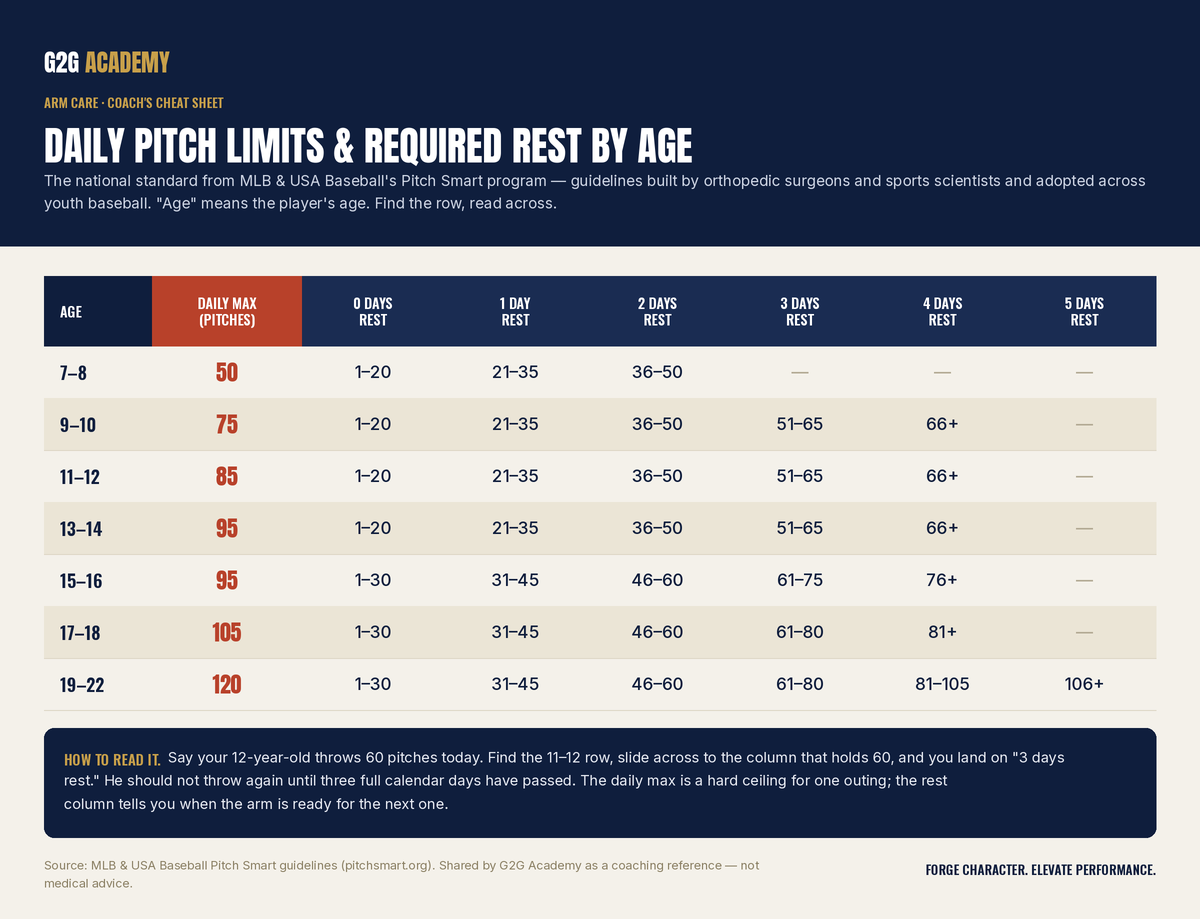
Youth baseball pitch count chart from MLB and USA Baseball's Pitch Smart program — daily pitch limits and required rest days by age, from age 7 through 22.
In-game limits if you play Little League
If your athlete plays in a sanctionedLittle League program, the in-game daily maximums line up with the chart above and are enforced by the league:
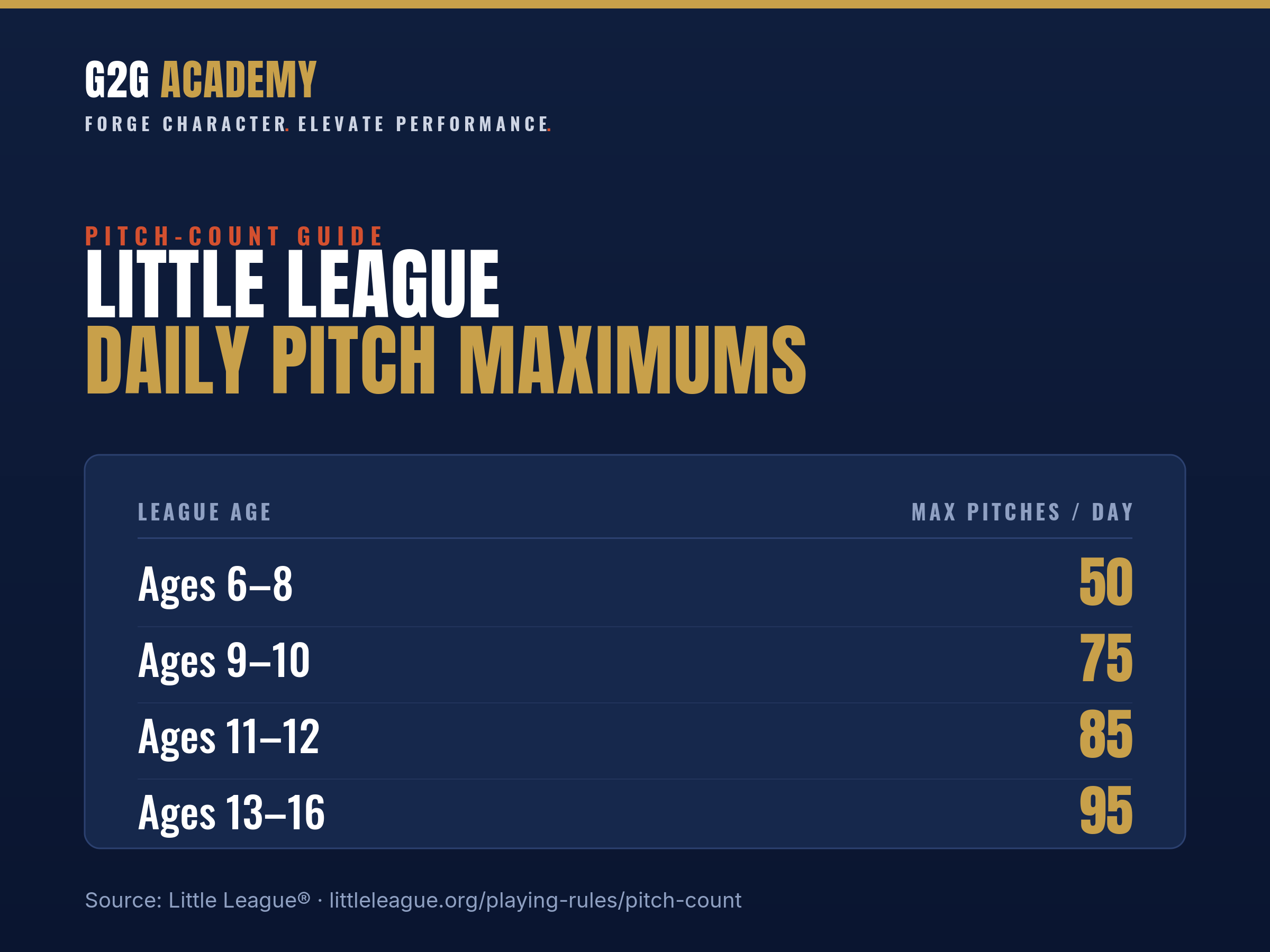
Little League daily pitch count maximums by age, ages 6 to 16
Why the rest column is the part that matters
It is tempting to treat the daily max as the only number. The rest column is where arms actually get protected, and here is why.
The driving factor in youth arm injuries is fatigue. Research from the American Sports Medicine Institute found that a young pitcher who regularly throws while fatigued faces a dramatically higher risk of a serious shoulder or elbow injury. The pitch count is not a bureaucratic hoop. It is a fatigue meter. Stay inside it and you stay inside the margin of safety.
Watch for the tells that fatigue has arrived before the count does: velocity dropping, the ball sailing high, the pitcher rushing or short-arming, a little shake of the arm between pitches. The number on the counter is the rule. Your eyes are the override. If your athlete is laboring, the day is done even if there are pitches left on the card.
Beyond the count: the arm-care habits that matter just as much
Pitch counts handle a single game. Most overuse damage builds over a season and a year. Dr. James Andrews, one of the most respected voices in sports medicine and a longtime advisor to youth baseball, points to a handful of risks that live outside the box score. His full guidance is worth reading; here is the short version for a busy parent.
Take real time off. Young players should have at least two to three months a year completely off from overhead throwing. Even professionals shut it down in the offseason, and a developing arm is far more vulnerable than a grown one. A year-round throwing schedule is the number-one risk factor there is.
Don't stack leagues. Pitching in two leagues at once makes the official limits almost impossible to track, and the counts quietly pile up. Pick a primary commitment and protect it.
Keep the radar gun in perspective. Chasing velocity numbers pushes a young arm past its safe limit, often before the ligament is mature enough to handle it. Build the engine first. The speed comes.
Be patient with the breaking ball. Curveballs demand control and physical maturity most young players do not have yet. The common guidance is to wait until the body has matured before making them a regular part of the mix, and to prioritize clean mechanics on every pitch in the meantime.
Where this fits into actually developing a pitcher
Here is the part we care about most at G2G. A pitch count tells you when to stop. It does not, by itself, build a pitcher. The arm that lasts is the one attached to an athlete who understands their own workload, prepares the body that throws the ball, and treats arm care as part of the craft rather than a rule imposed from the dugout.
That is the difference between counting reps and developing a player. We would rather your athlete leave understanding why the rest day matters than simply being told to take it. When a young pitcher owns their own arm care, that is ownership in the truest sense, and it is exactly the kind of habit that outlasts the cleats. Person before player, on the mound like everywhere else.
It is also why our Pitching Development work is one-on-one. Workload, mechanics, and recovery are personal. They are coached best one arm at a time, by someone who has recently lived the climb. We build baseball and softball athletes here for the long game, not the radar gun.
The one-line takeaway
Find your athlete's age on the Pitch Smart chart, respect the daily max, and honor the rest column every time. Add real months off each year, skip the second league, and let velocity be a result rather than a goal. Do those things and you protect the most important piece of equipment your athlete owns.
Want to talk through your young pitcher's development the right way? Tell us about your athlete and we will be in touch as programs open.
We coach the person before the player, and the long game is the only game we play.
— Bryan Danek Co-Founder, G2G Academy
Forge Character. Elevate Performance.
