
The 7% Question
CLOSING THE GAP · Issue 04
A national outlet just handed every baseball and softball parent a number. Here is what to do with it.
CNN published a tool this week that puts a number on the question a lot of families around Dexter, Chelsea and Ann Arbor are quietly asking. About 7 percent of high school athletes go on to play on a college roster at any level. About 2 percent earn an NCAA athletic scholarship. The analyst behind the numbers, Patrick O’Rourke of ScholarshipStats.com, went one step further and said that if it were his money, he would skip the youth sports spending and put it in a 529 plan, “because that’ll play for college no matter what.”
Baseball and softball run a little better than the average. The NCAA’s own figures for 2024-25 show 8.8 percent of high school baseball players and 6.5 percent of high school softball players landing on an NCAA roster, and under 3 percent at Division I in either sport. Add junior college and NAIA and the number climbs a bit. It is still a small number.
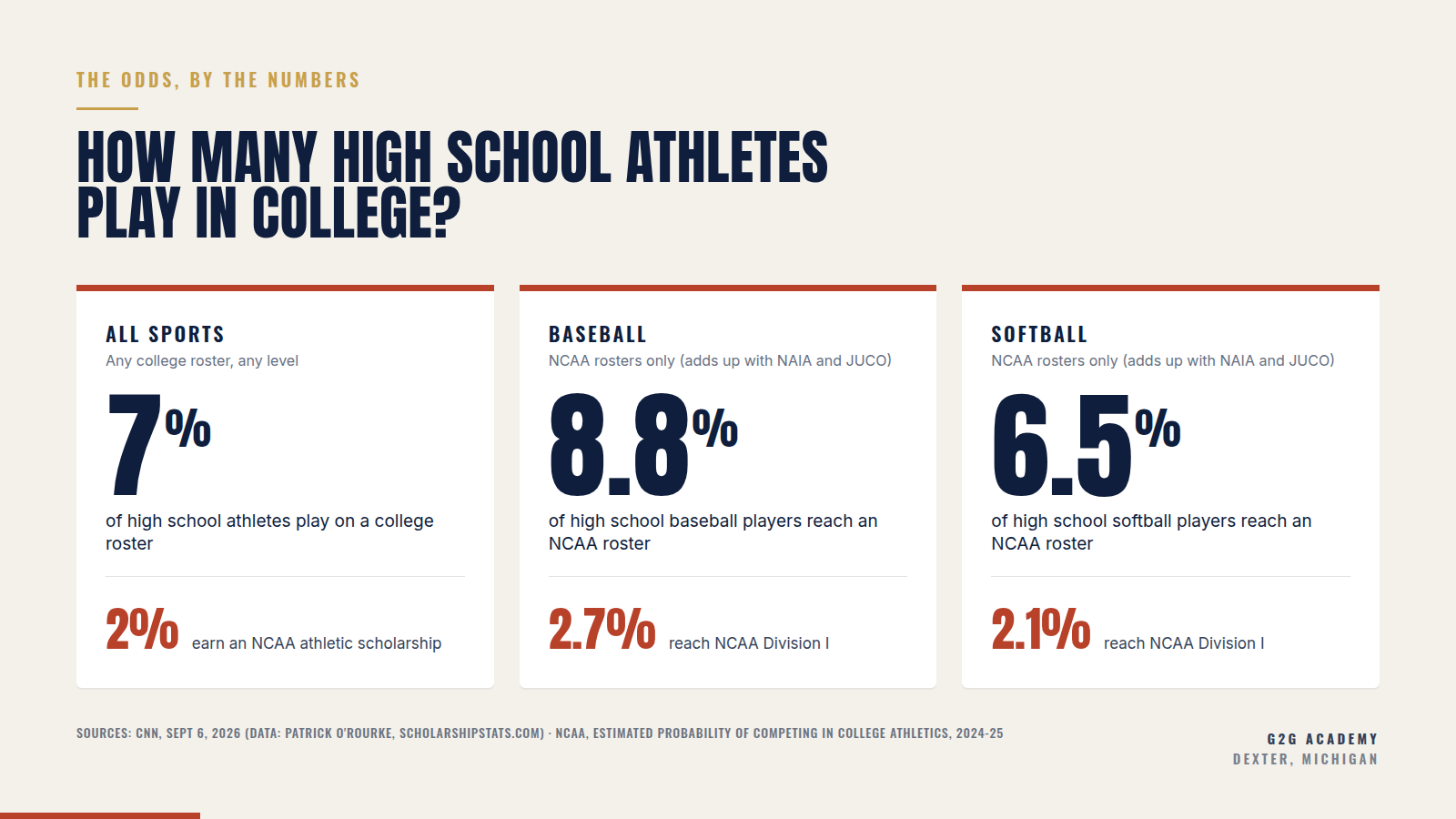
The odds, by the numbers. Sources: CNN, Sept 6, 2026; NCAA, 2024-25.
We are not going to argue with it. We are going to ask a better question.
The number is not the problem
Most of the athletes who walk through our doors this fall will not play college baseball or softball. Everyone in the building knows that, including the athletes. Pretending otherwise is how families end up spending years chasing a roster spot that was never really the point.
Here is what the number cannot tell you. It says nothing about whether the training was worth doing. It only tells you the odds of one particular outcome, and it assumes that outcome is the reason you showed up.
So before you decide what 7 percent means for your family, get clear on what you are actually building for.
Two different gaps
There is the gap between your athlete and a college roster. That gap is mostly out of anyone’s hands. Roster size, position, what a program happens to need that year, who else showed up. You can work at it, but you cannot close it on your own, and nobody can close it for you.
Then there is the other gap. The distance between where an athlete is right now and what they are capable of. That one belongs to you. It closes one honest rep at a time, and it is worth closing whether or not a coach with a clipboard ever writes the name down.
At G2G we call that the Gap, and it is the only one we sell.
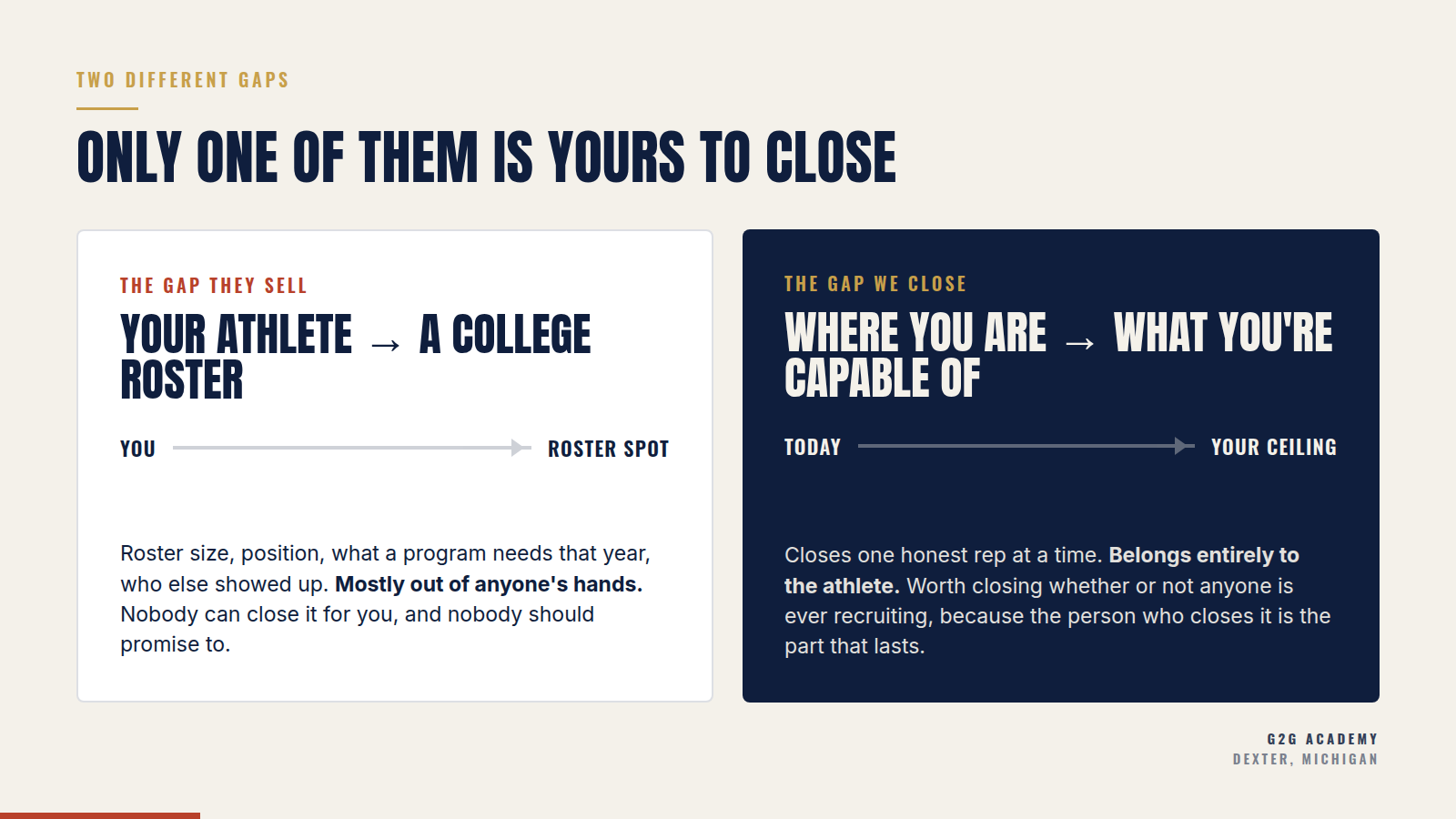
Two different gaps. Only one of them is yours to close.
What a program can promise honestly
A good program can promise a handful of things, and they are all things you can see.
Better mechanics, built on purpose instead of patched together between games. A body that holds up, because arm care, strength and mobility got treated as part of the work rather than an afterthought. A real plan for the offseason instead of a long wait for spring. And the habit of doing hard things on a Tuesday night when nobody is watching and nothing is on the line.
That last one is the whole game. The athlete who shows up to a standard on the days they do not feel like it is building something the radar gun cannot measure.
What a program cannot promise
A roster spot. A scholarship. A phone call from a college coach.
Anyone selling you those is selling you the 7 percent. What we can tell you is that the athletes who do end up in that 7 percent almost always got there by closing the first gap, the one that belongs to them, for a long time before anyone was recruiting.
“Anyone selling you a roster spot is selling you the 7 percent.”
The return that pays either way
This is where the person matters more than the player.
The kid who learns to Solve a problem in the cage, who can look at a bad at bat and ask what went wrong instead of who is to blame, is learning something that goes with them. It goes into the classroom. It goes into a first job. It goes into every hard conversation they will ever have with a coach, a boss or a teammate. Communication, Ownership, Maturity, Resilience. We name those four on purpose, because they are the part of the work that pays no matter which way the roster goes.
The skill win and the character win are not two different projects. They happen on the same rep. You cannot build one without the other, and you should not want to.
If you are an athlete and reading this
This part is for you, not your parents.
The number is not a reason to quit. It is a reason to train for something that belongs to you. And there is good news inside it: almost everything that makes an athlete better is in your control, and almost everything the number is about is not.
You cannot control how big a college roster is, what position a program needs next year, who else shows up to the same tryout, or what kind of day a coach was having when your name crossed their desk. Nobody can. Chasing those things is chasing the weather.
You can control whether you showed up today. How you warmed up. Whether you took the rep seriously when nobody was counting. How you talked to a teammate after they made an error. What you did with a bad at bad, blame the umpire or figure out what went wrong and fix it. Whether you were coachable when the correction stung. Whether you went to bed on time.
None of those show up in a percentage. All of them show up in who you are by the end of the season. Stack enough of them and you become the kind of athlete a coach notices. More important than that, you become the kind of person who is good at hard things, and that is a skill you keep for the rest of your life. No roster decision can take it from you.
So stop asking whether you will get recruited. Start asking whether you are better than you were in June, and whether your teammates are better for having you around. Those two questions are on you, and you get to answer them every single week. That is not a consolation prize. That is the whole point.
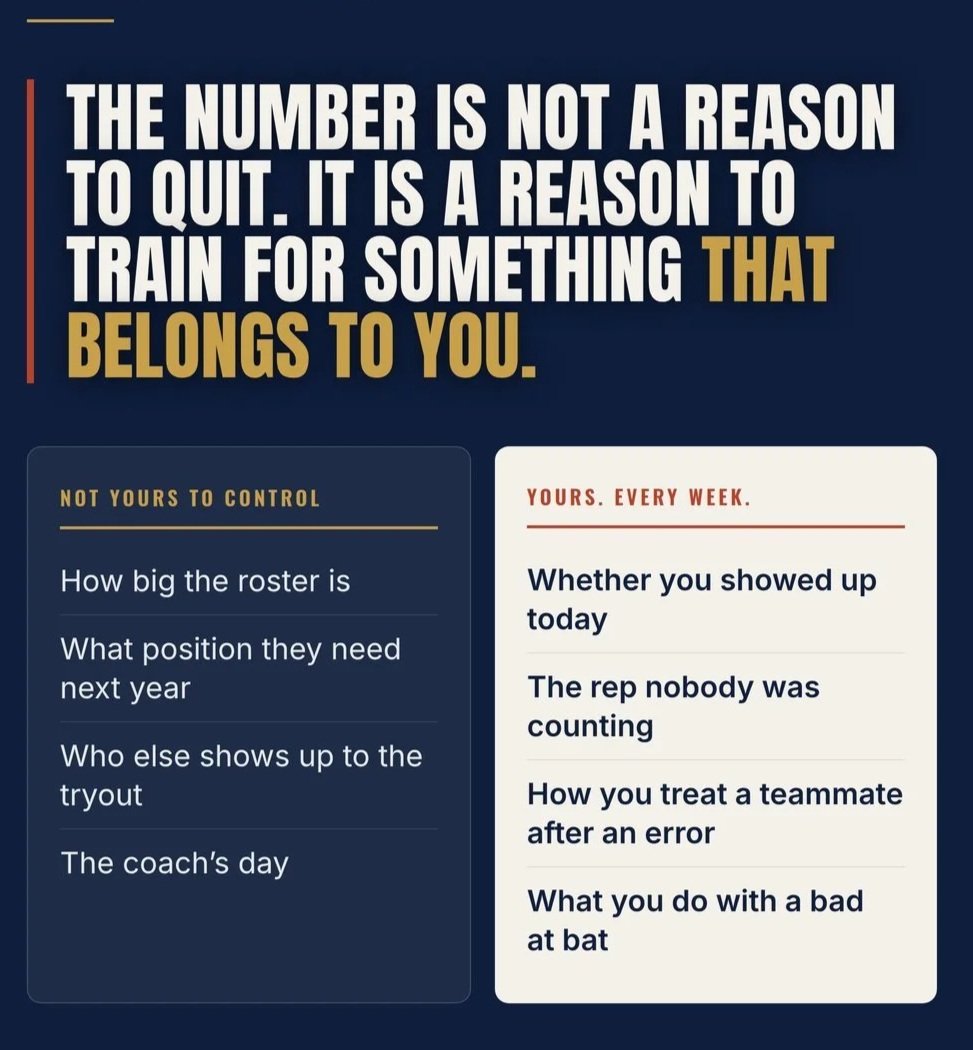
The number is not a reason to quit. It is a reason to train for something that belongs to you.
What the 529 guy got right
O’Rourke is right about one thing, and it is worth saying plainly. If the return you are counting on is a scholarship, youth sports is a poor investment. Be honest with yourself about what you are buying.
Buy training because your athlete is going to get better and become someone you are proud of. Buy it with your eyes open, at a price you can see. That is the standard we hold ourselves to, and it is the reason we put our prices on the website instead of behind a sales call.
The Standard
We train the person first because the person is the part that lasts. The Standard does not change when the odds do. Whether your athlete ends up in the 7 percent or the 93, the work looks the same, and so does what they carry out of the building.
Sources: CNN, “Fall sports are here. See how likely that sport is to take a kid to college,” Alex Leeds Matthews, September 6, 2026 (data: Patrick O’Rourke, ScholarshipStats.com). NCAA, Estimated probability of competing in college athletics, 2024-25 figures.What's Next
All programs require an assessment to ensure your athlete is matched with the correct squad. Sign up for our free Assessment and use code NEWUSER.
Our first 8-Week Programs start September 26th: Softball and Baseball Hitting & Fielding and Pitching Development. 32 baseball and 32 softball athlete spots total. That number is not a sales tactic. Four athletes to a coach, or one, is simply how many we can develop the right way at once, the same way we build the person before the player.
Come visit us at our Open House on September 13th, 5-7 pm, to meet our coaches and tour the facility. Pizza and beverages provided!
BRYAN DANEK
Co-Founder, G2G Academy
